
Himalayan Balsam in Woodland: What It Is & Why You Need to Remove It
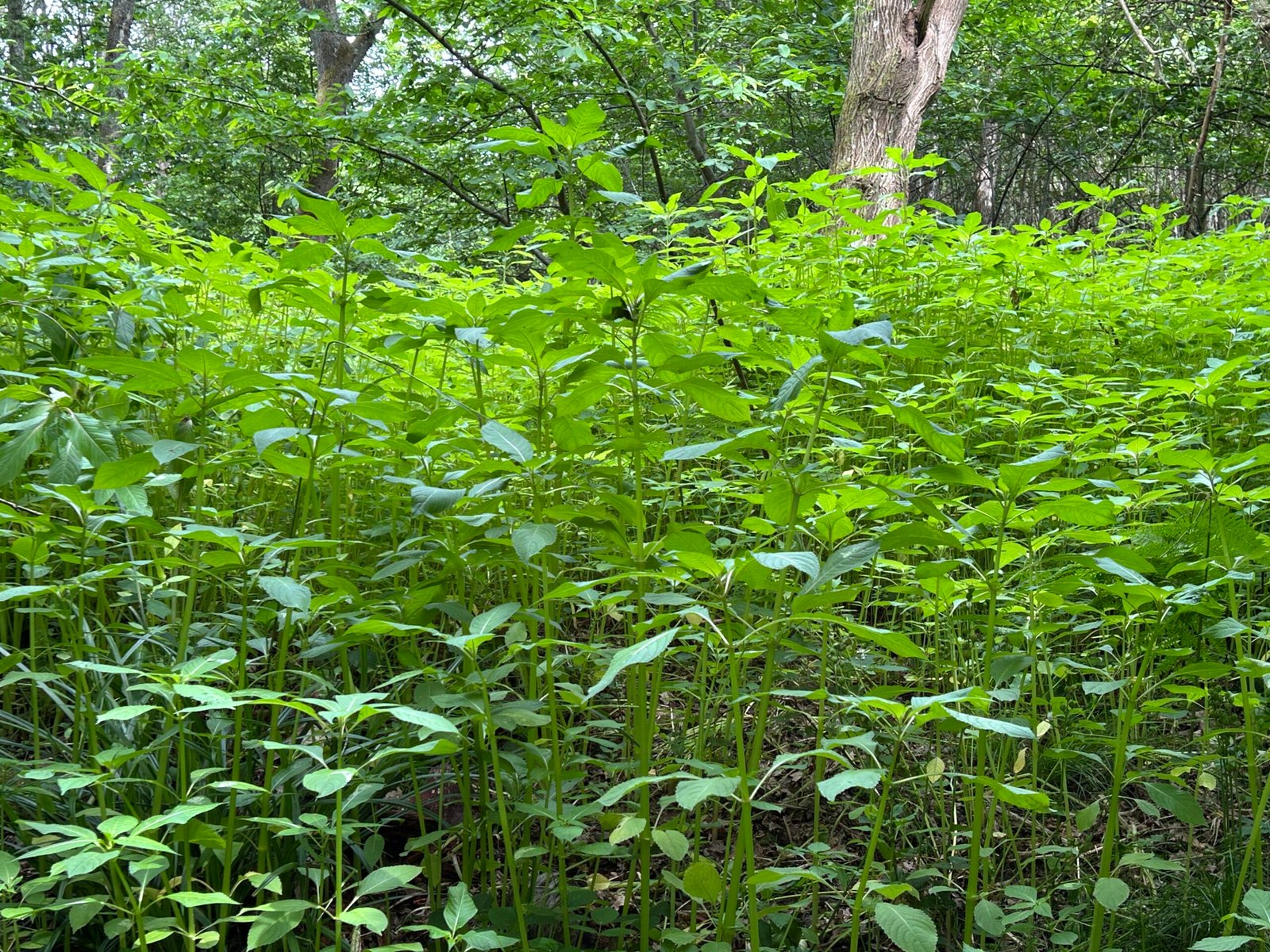
If you own or manage woodland in the UK, it’s possible that you’ve come across Himalayan balsam, especially if you have watercourses or are close to rivers. Even if you didn’t know its name, you can’t miss it if you have it come summer. This tall, pink-flowered plant turns up along streams, in damp hollows and on woodland edges from April onwards and more noticeable from June. It looks harmless enough. It isn’t. Left alone, it will spread through your woodland, crowd out native plants and leave bare, eroding ground behind it. Here’s what it is, why it matters, and what to do about it.
What is Himalayan Balsam?
Himalayan balsam (Impatiens glandulifera) is a tall annual plant, native to the western Himalayas as its name suggests. It was brought to Britain in 1839 as an ornamental garden plant, prized for its scent and its showy pink-to-purple, helmet-shaped flowers, which is where its common nickname “policeman’s helmet” comes from. It didn’t stay in gardens for long. It escaped into the wild and has since spread widely across England, Wales and Northern Ireland, with smaller populations in Scotland.
It’s easy to identify once you know what to look for. Plants grow rapidly through spring and summer, reaching around two to two-and-a-half metres by late summer, with hollow, reddish-tinged stems and lance-shaped, serrated leaves. Flowers appear from June through to October, followed by seed pods that explode when ripe, flinging seed up to around seven metres from the parent plant. A single plant can produce roughly 800 seeds, which is a large part of why it spreads so quickly once established.
Why it’s a problem in your woodland
Himalayan balsam causes several distinct problems for woodland and landowners, and they compound each other over multiple years if the plant isn’t tackled early.
- It out-competes native flora. It grows fast, shades out slower-growing native plants for light and space, and can form dense, near-total stands that push out the woodland flora your management plan is probably trying to protect.
- It leaves ground bare over winter. Because it’s an annual, the whole stand dies back completely after the first frosts, leaving bare soil on banks and slopes with nothing left to hold it together. On stream and riversides and damp woodland edges, this significantly increases the risk of erosion.
- It reduces biodiversity, not just plant cover. Native insects and other wildlife that depend on the plants balsam displaces can lose their food source. One documented example is the tansy beetle, a highly endangered species whose population was reduced to a single site partly because its sole food source, native tansy, became scarce due to competition from Himalayan balsam, among other pressures.
- It’s part of a wider, costly problem. Invasive non-native species as a group are estimated by Defra to cost the UK economy over £2 billion a year. That figure covers all invasive non-native species, not Himalayan balsam alone, so treat it as context rather than a balsam-specific cost.
The legal position — and what to check before you act
Himalayan balsam is listed under Schedule 9 of the Wildlife and Countryside Act 1981, and it also appears on Defra’s list of invasive alien plant species that are “widely spread” in England and Wales (it was listed on 2 August 2017). In practice, this means it’s an offence to plant it, or to intentionally cause it to grow or spread in the wild. If it’s already growing on your land, having it there isn’t itself an offence, and you’re not legally required to remove it — but you are required not to let it spread, and Defra’s guidance recommends removing and disposing of it safely where you can.
Penalties for breaches can include a warning, a compliance or restoration notice, a fine, or in serious cases imprisonment (up to three months for a summary offence, or two years for an indictable one), according to GOV.UK guidance. Disposal has its own rules too: cut or pulled balsam, and any soil containing its seed, is regarded as controlled waste, so if you’re moving it off site you need to use a registered waste carrier and an authorised disposal site, and you should tell the Environment Agency if you’re removing it from a riverbank.
This is an area where the detail matters and rules do get updated, so before you rely on any of the above for a specific decision, please verify it against the current GOV.UK guidance page (linked in the sources below) rather than this article. I’ve drawn the legal points here directly from the live GOV.UK page as it read on 3 July 2026, but treat this section as a starting point for your own check, not a substitute for it — this is approximate, it needs verification against the current page before you act.
How to control and eradicate Himalayan Balsam
The good news is that, unlike some invasive species, Himalayan balsam is genuinely manageable. It’s shallow-rooted and annual, so it doesn’t have the underground network of something like Japanese knotweed, and it isn’t harmful to touch (unlike giant hogweed).
- Pull or cut it before it flowers and sets seed. Timing is everything: because the whole population relies on that year’s seed, removing plants before the seed pods form prevents the next generation. Cut below the lowest node, since it can regrow from a node left in the ground.
- Plan for more than one season. A single clearance rarely finishes the job, because seed can persist in the ground and germinate in following years. Most successful eradication involves repeat visits across a few seasons until the seed bank is exhausted.
- Dispose of cut material responsibly. Where possible, leave it on site to rot down away from watercourses. If you need to move it off site, remember it’s controlled waste under the Environmental Protection Act, so it needs a registered waste carrier and an authorised site.
- Consider herbicide only where hand control isn’t practical. It can be effective, but near water you’ll need agreement from the Environment Agency, and in protected sites you’ll need permission from Natural England.
- Re-establish native cover once it’s gone. Bare ground left behind is vulnerable to erosion and to reinvasion, so replanting with native species that suit the site helps hold the ground and out-compete any seedlings that do come through.
Practical takeaways
Early, repeated, well-timed removal is what gets on top of it, whether you’re managing two acres or two hundred.
- Walk your woodland margins and streamsides from April, in June and July balsam is easiest to spot in flower.
- Pull before seed pods form, this is the single most important timing decision.
- Budget for at least two to three seasons of follow-up, not a one-off clearance.
- Check the current GOV.UK guidance before disposing of cut material or using herbicide near water.
- Fold balsam control into your wider woodland management plan so it’s tracked and reviewed, not a one-off job that gets forgotten.
If Himalayan balsam (or another invasive species) is already established on your land, getting it into a proper management plan makes it far easier to stay on top of, and it’s often something funders want to see addressed as part of a wider woodland management plan.
If you’d like help putting a plan together, Alison at MicroWild can help you complete surveys and write invasive species management plans that cover invasive species control alongside the rest of your woodland’s management — have a look at our woodland management services, or get in touch to talk through what’s on your land.

Sources
GOV.UK — Invasive non-native (alien) plant species: rules in England and Wales: https://www.gov.uk/guidance/invasive-non-native-alien-plant-species-rules-in-england-and-wales
GOV.UK — How to stop invasive non-native plants from spreading: https://www.gov.uk/guidance/prevent-the-spread-of-harmful-invasive-and-non-native-plants
Defra Environment blog — Preventing the spread of invasive plants from your garden (£2bn economic cost figure, tansy beetle example): https://defraenvironment.blog.gov.uk/2024/02/23/preventing-the-spread-of-invasive-plants-from-your-garden/
RHS — Himalayan balsam: https://www.rhs.org.uk/weeds/himalayan-balsam
The Wildlife Trusts — Himalayan balsam: https://www.wildlifetrusts.org/wildlife-explorer/wildflowers/himalayan-balsam
Canal & River Trust — Himalayan Balsam: https://canalrivertrust.org.uk/things-to-do/canal-and-river-wildlife/canal-and-river-invasive-species/himalayan-balsam
BBC Gardeners’ World Magazine — What is Himalayan Balsam?: https://www.gardenersworld.com/how-to/solve-problems/himalayan-balsam/
Dayinsure / Woodland Trust — Himalayan Balsam Bashing with the Woodland Trust (Smithills Estate example): https://www.dayinsure.com/news/himalayan-balsam-bashing-with-the-woodland-trust/
Rhododendron: The Woodland Strangler that Needs to Go
Rhododendron Ponticum: The Woodland Strangler that Needs to Go There are many things to thank…
Himalayan Balsam in Woodland: What It Is & Why You Need to Remove It
Himalayan Balsam in Woodland: What It Is & Why You Need to Remove It If…
The Understorey Bulletin: October 2025
Your Understorey Bulletin: October 2025 Hello there! Here’s your nature news. Pull up a chair…
Why Every Woodland Owner Should Have a Management Plan
You’ve just become the proud owner of a patch of woodland, or perhaps you’ve had…
New Gateway Opens at The Ashdown Forest Centre
As a Trustee of the Ashdown Forest Foundation, I was delighted to attend the grand…
Hazel: Your Nutty Native Woodland Treasure
Scientific Name: Corylus avellana We’ve all seen hazel, whether you noticed it or not. This small…