
Rhododendron Ponticum: The Woodland Strangler that Needs to Go
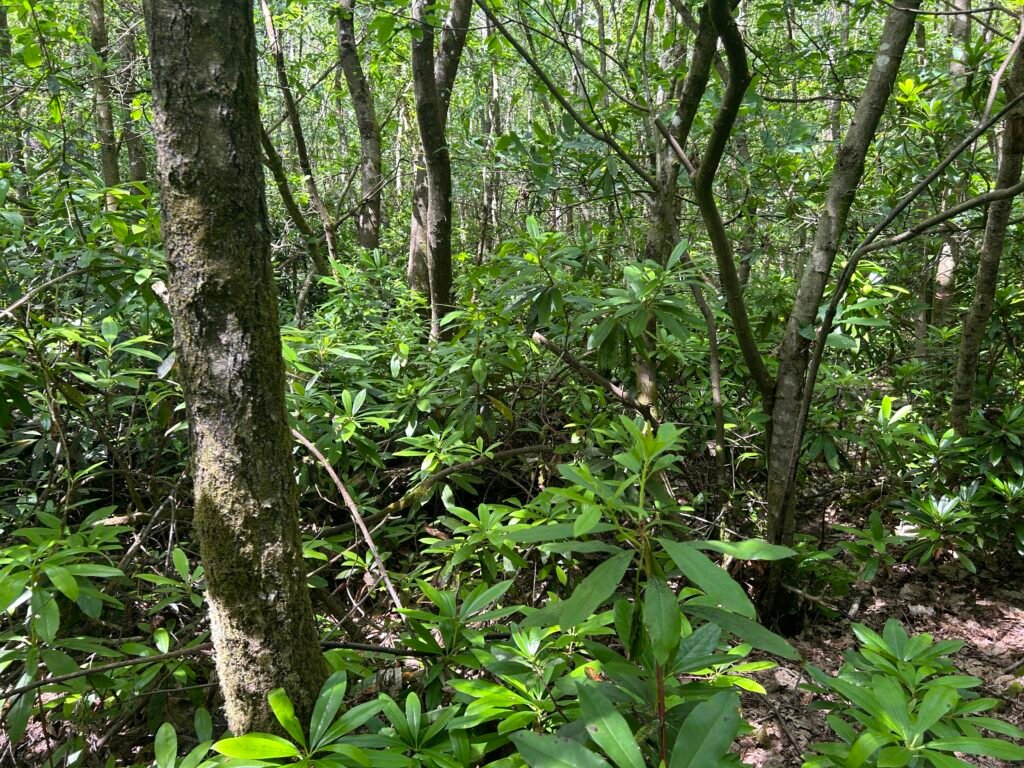
There are many things to thank the Victorians for but their love of exotic flora has left us with a very big problem. Famed for its beauty, rhododendron looks incredible when it flowers for a few weeks in May and June but its wall of solid green that remains for the rest of the year, chokes woodlands of light and reduces biodiversity. It’s one of the most damaging invasive species found in British woodland. Here’s what it is, why it matters, and what you can do about it.
What is Rhododendron ponticum?
Rhododendron ponticum is a large evergreen shrub, native to two quite different parts of the world: the Iberian Peninsula (Spain and Portugal) and the area around the Black Sea and Caucasus. According to a Forestry Commission practice guide, it was brought into Britain around 1763 as an ornamental plant for gardens, parks and country estates, and it became especially popular on Victorian hunting estates, where it was planted for game cover. It was later used as rootstock for more delicate rhododendron varieties, and that rootstock frequently outgrew and replaced the grafted plant, reverting to its wild, invasive form. Breeders also crossed it with hardier North American species, which is part of why it copes so well with British winters.
You can identify it by its leathery, dark green, oblong leaves and its funnel-shaped purple to pink flowers, which appear in late spring. Left alone, it doesn’t stay a modest shrub. Easily reaching 5m in height, it grows into a dense, many-stemmed thicket, and its branches root wherever they touch the ground, so a single plant can spread sideways as well as by seed.
Why Rhododendron a problem in your woodland
Left unchecked rhododendron becomes a big problem for the health of your woodland.
- It blocks light completely. Its dense, evergreen canopy shades the woodland floor all year round, not just in summer, so native ground flora, tree seedlings and natural regeneration all struggle or fail beneath it.
- Rhododendron ponticum’s nectar is toxic to honey bees and you’ll notice that in the darkness, with lack of biodiversity, there will also be a noticeable lack of invertebrates.
- It damages the soil. Its leaf litter is acidic and slow to break down, which changes soil pH and nutrient balance, and the plant also releases chemicals that appear to suppress the germination and growth of other species nearby, according to Scottish Forestry.
- It doesn’t bounce back quickly on its own once removed. A study by Maclean and colleagues, published in 2017 and summarised by ecological consultancy Inside Ecology, found that native plant communities in parts of Scotland had not returned to their pre-invasion state even thirty years after rhododendron was cleared. Worth knowing before you assume clearance alone will do the job.
- It’s a disease reservoir. Rhododendron can act as a host for Phytophthora ramorum, a fungus-like pathogen that has caused serious damage to larch in the UK, according to GOV.UK’s own guidance on the rhododendron control grant item.
- It adds to a wider, costly problem. Invasive non-native species collectively are estimated by Defra to cost the UK economy over £2 billion a year; this figure covers all invasive species, not rhododendron alone, so treat it as context rather than a rhododendron-specific cost.
Your management obligations for Rhododendron
Rhododendron ponticum is listed under Schedule 9 of the Wildlife and Countryside Act 1981. This means it’s an offence to plant it, or otherwise cause it to grow, in the wild. If it’s already established on your land, that isn’t itself an offence, and there’s no legal duty on private landowners to remove it, but you must not allow it to spread further.
Answers given in the UK Parliament confirm there are currently no plans to ban the sale of Rhododendron ponticum in England, partly because it’s already so widespread that national eradication isn’t considered achievable with current techniques. That doesn’t mean control at the level of your own woodland is pointless. Quite the opposite. Locally, it’s genuinely achievable, and it’s one of the more cost-effective things you can do for the biodiversity of your site.
As with any legal question, rules and enforcement can shift, so treat this as a starting point rather than a substitute for checking current guidance yourself. This is my understanding as verified against GOV.UK and Parliament sources today; it needs checking against the live pages (linked below) before you rely on it.
How to control rhododendron in woodland, and what funding is available
The good news is that, unlike many invasive species, rhododendron control is well understood, and in England there’s dedicated grant funding to help pay for it.
- Cut all live material back to the stump, then treat the stump with a suitable herbicide on the same day, in frost-free, rain-free conditions. GOV.UK’s guidance for the rhododendron control grant item specifies this sequence, because rhododendron re-grows vigorously from cut stumps left untreated.
- Plan for follow-up treatment. Regrowth needs further chemical treatment, and most sites need more than one season of work before the plant is properly under control.
- Think about disposal early. Cutting, and any burning of waste material, needs to be planned with your Forestry Commission or Natural England adviser, particularly near protected habitats, scheduled monuments, or where the material is infected with Phytophthora.
- Get a woodland management plan in place first (we can help with that). For most sites, a Forestry Commission-approved plan that specifically identifies rhododendron as a threat is a requirement before you can claim the main rhododendron control grant (this doesn’t apply if you’re removing infected material purely for tree health reasons).
On funding: the current Countryside Stewardship / Capital Grants item SB6: Rhododendron control pays between £3,500 and £5,500 per hectare, depending on the slope of the site and the height of the rhododendron, according to the current GOV.UK guidance (last updated 19 February 2026, so this is live and current as I’ve checked it). It can also be delivered through a Woodland Tree Health grant where the rhododendron is infected with Phytophthora. Writing the woodland management plan itself is separately grant-funded through item PA3, which currently pays a flat £1,500 for eligible woodland between 0.5 and 50 hectares, rising for larger holdings. Microwild writes management plans to help woodland owners manage and control rhododendron.
I’m confident in these figures as they stand on GOV.UK today, but Defra grant schemes are reviewed and updated frequently, sometimes several times a year. Please verify current rates and eligibility on GOV.UK before you rely on them for a funding decision: this is approximate, it needs verification against the live page before you plan or budget around it.
Practical takeaways
- Walk your woodland in late spring, when the purple-pink flowers make rhododendron easy to spot and map. Look out for seedlings as well.
- Get a woodland management plan in place. It protects your site and it’s usually the gateway to grant funding for control work.
- Budget for several seasons of follow-up treatment, not a single clearance.
- Check current GOV.UK guidance on funding rates and legal requirements before you commit, since both are reviewed regularly.
- Don’t expect the ground flora to bounce back overnight once rhododendron is gone. Restoration is a longer job than clearance. Consider strategies for biodiversity and planting following removal.
If you have rhododendron established on your woodland, getting it into a proper plan makes both the funding and the practical side of control far easier to manage, and it’s exactly the kind of habitat threat that funders want to see addressed within a wider woodland management plan.
If you’d like help with a woodland management plan or an invasive species management plan that covers rhododendron control alongside the rest of your woodland, MicroWild can help with surveys, writing the plan, and managing the grant application from start to finish.
Have a look at our woodland management services, or get in touch to talk through what’s on your land.

Sources
GOV.UK — SB6: Rhododendron control (Countryside Stewardship / Capital Grants): https://www.gov.uk/countryside-stewardship-grants/rhododendron-control-sb6
GOV.UK — PA3: Woodland management plan: https://www.gov.uk/countryside-stewardship-grants/woodland-management-plan-pa3
GOV.UK — How to stop invasive non-native plants from spreading: https://www.gov.uk/guidance/prevent-the-spread-of-harmful-invasive-and-non-native-plants
Forest Research / Forestry Commission — Managing and controlling invasive rhododendron (Practice Guide): https://www.forestresearch.gov.uk/publications/managing-and-controlling-invasive-rhododendron/
Scottish Forestry — Invasive rhododendron: https://www.forestry.gov.scot/invasive-rhododendron
UK Parliament — Written questions and answers, Rhododendron ponticum: https://questions-statements.parliament.uk/written-questions/detail/2022-12-01/100931
Woodland Trust — Rhododendron is destroying our native wildlife: https://www.woodlandtrust.org.uk/press-centre/2024/05/rhododendron-destroying-native-wildlife/
Defra Environment blog — Preventing the spread of invasive plants from your garden (£2bn economic cost figure): https://defraenvironment.blog.gov.uk/2024/02/23/preventing-the-spread-of-invasive-plants-from-your-garden/
Inside Ecology — Invasive non-native species (UK): Rhododendron ponticum (summarising Maclean et al., 2017): https://insideecology.com/2017/09/06/invasive-non-native-species-uk-rhododendron-ponticum/
Rhododendron: The Woodland Strangler that Needs to Go
Rhododendron Ponticum: The Woodland Strangler that Needs to Go There are many things to thank…
Himalayan Balsam in Woodland: What It Is & Why You Need to Remove It
Himalayan Balsam in Woodland: What It Is & Why You Need to Remove It If…

The Understorey Bulletin: October 2025
Your Understorey Bulletin: October 2025 Hello there! Here’s your nature news. Pull up a chair…
Why Every Woodland Owner Should Have a Management Plan
You’ve just become the proud owner of a patch of woodland, or perhaps you’ve had…
New Gateway Opens at The Ashdown Forest Centre
As a Trustee of the Ashdown Forest Foundation, I was delighted to attend the grand…
Hazel: Your Nutty Native Woodland Treasure
Scientific Name: Corylus avellana We’ve all seen hazel, whether you noticed it or not. This small…